Skip to content
GEGlobal Enterprise

Global Enterprise · cross-border M&A

Build the enterprise that can integrate the world.

For global enterprises, M&A is not only a capital event. It is the design of a shared operating system across energy, infrastructure, satellite and telecommunications, finance, marketing, and AI—translated into the local contexts where the promise has to hold.

A briefing room with maps and working papers arranged around a shared mission
Field note A cross-border deal becomes executable when the shared decision, local owner, and operating consequence are visible.

Global decision hubs

Bring world ideas together without flattening the context.

Decision lenses are used across regions where capital, infrastructure, communications, and regulation interact differently. Africa, the Caribbean, Latin America, South America, Europe, and Asia-Pacific are represented through our global advisory network.

The question is not whether one center can export a playbook. It is whether an idea, capability, or acquisition can travel between contexts without losing the evidence, authority, service promise, or local legitimacy that make it useful.

These are operating contexts and representative presence zones, not claims of physical office inventories. They help leadership teams bring different world views into the same M&A conversation while keeping the boundary between what is known, what is inferred, and what must be validated locally.

The global-enterprise test: can a capability learned in one hub be integrated elsewhere through a clear boundary, a local owner, and a service path that survives a different language, regulator, infrastructure route, or customer expectation?

Regional operating contexts

The integration thesis travels. The mechanism changes.

These are not office claims or a list of locations. They are the operating conditions we put into the room when an M&A mandate crosses borders, partners, institutions, and the systems that carry a service promise.

North America

Scale without losing the mission.

Large institutions are being asked to move at institutional speed while carrying public, regulatory, workforce, and infrastructure consequence. The useful question is which decisions belong close to the signal—and which require a shared control surface.

  • Mission and enterprise architecture
  • AI portfolio governance
  • Infrastructure and public value

Europe

Turn principle into operating practice.

Privacy, safety, resilience, competition, and digital sovereignty are not separate workstreams. They become an operating advantage when translated into product choices, data responsibilities, evidence, and a clear path for exception.

  • Responsible AI and data trust
  • Cross-border operating models
  • Regulation-to-workflow translation

Middle East & Africa

Build the platform and the capability together.

Ambitious transformation programs need more than capital and technology. They need local capability, durable institutions, delivery partners, and a sequence that lets a new system become useful before it becomes complex.

  • Institution building and capability transfer
  • Digital and physical infrastructure
  • Partner ecosystems and resilience

Asia-Pacific

Coordinate speed across a connected system.

Manufacturing, logistics, technology, health, and public systems often cross organizational and national boundaries. Advantage comes from making the interfaces, handoffs, and decision rights visible before the network is under stress.

  • Supply-chain and platform resilience
  • Interoperability and data products
  • Distributed leadership and change

Latin America & the Caribbean

Make trust part of the delivery architecture.

Transformation compounds when people can see who owns a decision, how data is used, and what happens when the system fails. Clear service promises and practical feedback loops are the infrastructure for adoption.

  • Public service and institutional trust
  • Inclusive capability building
  • Data, identity, and service design

South America

Build capability around continuity.

Capability has to survive weaker grid quality, uneven logistics, and local operational constraints. The advantage comes from defining what can be standardized versus what must stay local.

  • Infrastructure continuity
  • Decision-rights localization
  • Operational translation

Quiet institutional routing

A shared operating discipline, read through the mandate.

The regional view stays open to the conditions around the work. This filtered set helps public, national, international, and acquisition readers find the first-party context that matches the decision they carry.

Mandate owners

National, federal & international leaders

Presidents, prime ministers, ministers, federal CIO and architecture offices, and multilateral leaders looking for a path from mandate to a reliable national system.

Explore public-sector advisory

Primary home: Global Enterprise

Public institutions

State, local & education institutions

Governors' offices, mayors, state and local agencies, public universities, colleges, and K–12 systems looking for services and operating models that work close to the people who depend on them.

Procurement

Contracting officers, CORs & acquisition teams

Public-sector buyers and program officials who need clear scope, evidence, outcomes, security boundaries, and a procurement-safe starting point.

Review the vendor & trust pack

Primary home: Global Enterprise

The delivery model

M&A creates value when translation becomes capability.

An international integration is not a central template copied into local markets. It is a shared management system with enough room for context, language, law, and lived experience—and enough discipline to keep the combined enterprise coherent.

Shared standards create coherence. Local intelligence creates usefulness.

Global operating fabric

Connect the mandate, the network, and the local decision.

A shared operating fabric keeps standards coherent while letting evidence, context, and accountable judgment travel to the place where work happens.

  1. Translate

    Turn a shared ambition into local decision rules, service promises, and evidence that the people closest to the work can use.

  2. Coordinate

    Make the dependencies across time zones, partners, regulators, platforms, and capital visible enough to govern.

  3. Adapt

    Preserve the standard while allowing the workflow, language, risk boundary, and delivery rhythm to fit the context.

  4. Transfer

    Leave behind the capability, cadence, and ownership model required for the institution to keep learning after the engagement.

Read the diagram as a loop: translate the mandate, coordinate the dependencies, adapt to context, and transfer the capability that keeps the system learning.

Cross-border M&A

Treat the transaction as operating-system design.

A cross-border acquisition is not complete when the legal entities are aligned. It becomes useful when the combined organization can make decisions, keep promises, and recover across the boundaries the deal creates.

The integration thesis should be explicit about what becomes common, what remains local, and what must be jointly governed. That includes decision rights and data, but also customer promises, supplier dependencies, energy and connectivity, language, workforce practice, and the service paths people rely on.

The long view is not one center making every context identical. It is a federation of regional service systems linked by shared evidence, control intent, and learning—so an acquisition can add capability to the whole without erasing the conditions that made the capability work.

The practical test is simple: can a leader trace the shared ambition to a local decision, an accountable owner, the evidence behind it, and a recovery path when the preferred route is unavailable? If not, the integration is transferring ambiguity faster than it is transferring capability.

  1. 01 · Frame

    Name the promise before the synergy.

    Start with the service, mission, or customer promise the combined organization must protect. A deal thesis that names only revenue, cost, or footprint leaves the operating consequence implicit.

  2. 02 · Map

    Draw the interfaces that carry the deal.

    Map decision rights, identity, data, platforms, suppliers, energy, connectivity, finance, marketing, and local obligations. The legal boundary is one fact; the dependency boundary is the one people experience.

  3. 03 · Integrate

    Make the common layer deliberate.

    Decide what becomes shared, what stays regional, what remains local, and what must be jointly governed. Bounded autonomy is a design choice, not a temporary exception to central control.

  4. 04 · Transfer

    Leave behind a system that can learn.

    Set the owners, evidence, recovery paths, and review cadence before the integration is called complete. The goal is an operating system the institution can run after the transaction team leaves.

The physical and communications layer

Global reach is bounded by energy, infrastructure, and the path a signal can travel.

Digital platforms depend on power, cooling, connectivity, identity, data, people, and contracts. A corporate operating model that treats those conditions as back-office details will discover them as service failures, delayed decisions, or stranded investment.

Energy availability, facilities, permitting, cloud regions, terrestrial fiber, cellular and telecom providers, and satellite links each shape the feasible route. The work is to map the dependency, the authority, the alternate path, and the degraded-mode service promise before the incident makes the design for you. That is the infrastructure discipline a 2050 enterprise will need: not a promise of perfect continuity, but a system that can make a bounded choice and recover across contexts.

Energy and infrastructure

Make capacity part of the operating case.

Capital programs, grid or utility dependencies, data-center and facilities constraints, supply chains, workforce coverage, security, and community or regulatory interfaces should be read as one service chain. Finance can then see transition and resilience requirements; operations can see what it must be able to run; leadership can see which assumptions would change the investment.

Satellite, telecom, and global communications

Design the route, not just the channel.

Satellite and telecom paths can extend reach or provide an alternate route, but they also introduce their own latency, coverage, bandwidth, provider, terminal, identity, and regulatory conditions. A global communications plan therefore needs approved channels, message authority, multilingual terminology, time-zone handoffs, crisis fallback, and a clear point where local operators can act without waiting for the center.

Continuity is a network property. The objective is not to pretend every route is equivalent; it is to make the choice, the limit, and the recovery owner visible before a regional constraint becomes an enterprise surprise.

The commercial and service interfaces

Finance, marketing, and ITIL practices keep the promise honest.

The global operating system is tested at the seam between what the enterprise funds, what the market is promised, and what teams can support and improve.

Finance should see more than a synergy case. It should see the capital, capacity, transition work, resilience option, and operating ownership required for the service to hold. Marketing should see more than a launch calendar. It should see the local mechanism, language, partner path, and delivery capacity behind the promise.

ITIL practices give the service side a useful grammar: incident and request handling, problem learning, configuration and knowledge visibility, change and release control, service transition, and continual improvement. We use those practices to make change safer and more learnable, not to create method theater or claim a certification. In the long view, this is how the enterprise turns every release, failure, and recovery into portable operating knowledge.

Inspect the whole-of-government and international systems practice
Interfaces to make explicit in an international operating model
InterfaceQuestionUseful artifact
Finance ↔ operationsWhat capital, capacity, resilience, and transition work does the service promise require?Capital-to-service map
Marketing ↔ operationsWhat can the brand promise across regions, and what local mechanism makes that promise true?Promise-to-capability map
ITIL practice ↔ changeWhat can change safely, who can stop it, and how does the organization learn when the path fails?Service transition and recovery note
Center ↔ local edgeWhich decisions need a shared control surface, and which need proximity to the signal?Boundary and decision-rights register

Working boundary: References to ITIL practices here describe independent working fluency—not endorsements, certifications, or affiliations with a framework owner, vendor, or standards body. The language remains subordinate to the service promise, risk boundary, evidence, and people who operate the change.

Inspect the service and change practice

A concrete 2050 thesis

The advantage will belong to organizations that can recover at the interface.

By 2050, the durable multinational will be a federation of regional service systems linked by a common evidence spine. Africa, North America, Europe, Asia-Pacific, Latin America, and South America are not copies of a central playbook; they are distributed sources of idea, capital, infrastructure insight, market intelligence, and operating practice that must be translated back into one coherent execution model.

This is a design thesis, not a forecast or a footprint claim. It is concrete enough to test now: ask whether the next deal, platform, communications path, capital decision, and service change makes the organization more able to observe, decide, act, recover, and learn across boundaries.
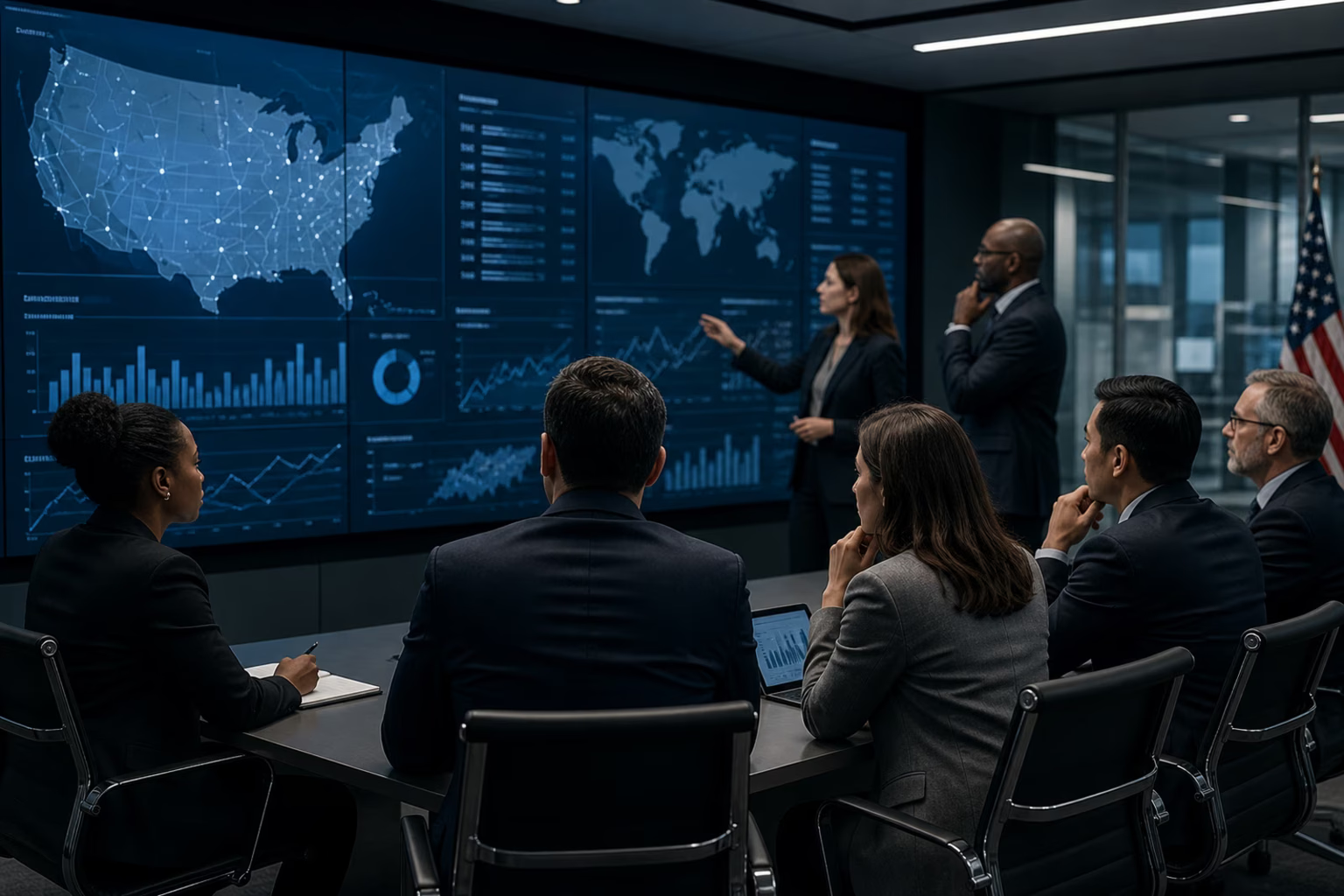
Transactions

M&A diligence will treat the target as a set of capabilities and interfaces to connect—not only a set of assets and financial statements.

Infrastructure

Energy, facilities, cloud, fiber, telecom, satellite, and recovery paths will be part of the service case because the digital promise depends on physical conditions.

Commercial system

Finance, marketing, product, and operations will share one view of the promise, the capacity behind it, the cost of resilience, and the evidence that should change the plan.

Management system

Service management, human judgment, and machine assistance will work as a learning loop: observe, decide, change, recover, and improve across regions without flattening them.

How to use the thesis: turn it into a boundary register, a dependency map, a service transition plan, and a review cadence. If an artifact does not make a decision, recovery path, or ownership boundary clearer, it is not yet earning its place.

Read the translation system perspective
Read the cross-border resilience perspective

What a 2050 enterprise keeps constant

The standard is not a template. It is a way of deciding together.

Evidence over theater. Make the source, caveat, and owner visible before a recommendation travels.

Context over shorthand. Let local operating reality change the mechanism without losing the outcome.

Capability over dependency. Transfer the practice, not only the deliverable.

Continuity over launch. Design the recovery, learning, and change rhythm before the new system is celebrated.

The Global Brief

One standard. Translated for the system in front of you.

A substantial field guide for leaders coordinating AI, infrastructure, data, and capability across regions, partners, and time zones—with a translation framework, context lens, management artifacts, worksheet, source notes, and explicit limitations.

  • A cross-border decision frame and context lens
  • Management artifacts for local adaptation
  • A worksheet, source notes, and practical first move

Public forms are for routing and context only; do not submit sensitive, classified, export-controlled, patient, or credential information. Company email required: Gmail, Yahoo, Hotmail, and Outlook.com accounts are not eligible for this brief. The required fields are enough to request the guide; the optional fields help us route a relevant follow-up.

Delivery details
Decision context

These short choices help us understand the decision context without asking for sensitive operating details. The planning horizon is optional.

Contact preferences

Start with the real question

Composure is a competitive advantage when the world is changing quickly.

The first useful move is making the system legible enough to choose what comes next without creating unnecessary motion.

The work begins with the decision, not a perfect brief.

Request a leadership engagement